


Ultherapy Expert in Sydney — Dr Stephen Lowe
Dr Stephen Lowe is internationally recognised for his expertise in Ultherapy and non-surgical lifting, with a clinical approach grounded in anatomy, precision, and long-term outcomes.
His work extends beyond clinical practice to the education of doctors and the development of treatment protocols internationally.
In a field often focused on surface-level change, his approach is centred on structure — where meaningful lifting actually occurs.
For a detailed overview of how Ultherapy works, including suitability and expected outcomes, explore Ultherapy in Sydney.
Ultherapy in Sydney — Why Expertise Matters
Ultherapy is widely available, but outcomes vary significantly depending on how the treatment is performed. Understanding why outcomes vary between patients is an important part of making an informed decision about treatment.
In Sydney, many clinics offer Ultherapy as a standard procedure. However, achieving meaningful lifting requires:
- Accurate assessment of facial structure
- Correct depth selection
- Strategic treatment planning
Without this, results are often limited to subtle skin tightening rather than true structural support.
The difference is not the treatment — it is how the treatment is delivered.
A Clinical Approach to Non-Surgical Lifting
Ultherapy is often described as a non-surgical lifting treatment. In practice, achieving meaningful outcomes requires a far deeper understanding of facial anatomy and ageing. This is particularly relevant when considering non-surgical lifting treatments, where outcomes depend on structure rather than surface-level change.
Facial ageing is not simply a surface-level process. It involves changes in ligament support, fat pad positioning, and structural integrity. As a result, lifting cannot be achieved through superficial treatments alone.
Dr Lowe’s approach focuses on identifying where structural support has diminished and delivering treatment at the appropriate depth and location to support natural repositioning.
Most treatments improve the surface — but lifting only happens when structure is addressed.
Global Involvement in Ultherapy Education and Development
Dr Lowe’s expertise is recognised internationally through his involvement in education, training, and clinical development.
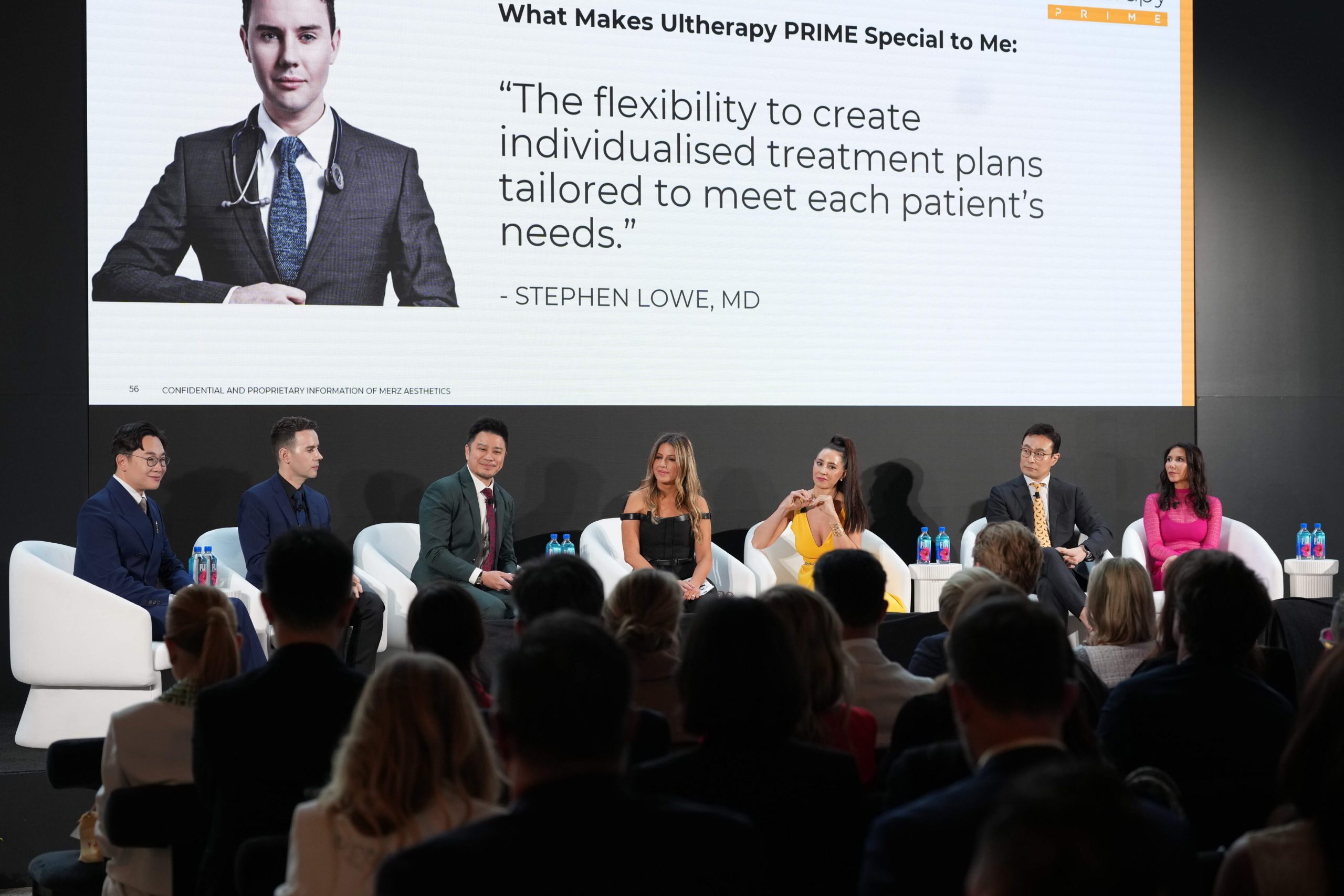 Dr Stephen Lowe presenting at the Ultherapy PRIME global launch in New York, contributing to international discussions on treatment planning and the clinical evolution of non-surgical lifting.
His roles include:
- Key Opinion Leader — Merz Aesthetics
- Global trainer in non-surgical lifting techniques
- Founding member of the Ultherapy Global Taskforce
- Contributor to the development of Ultherapy PRIME
Through this work, he collaborates with leading practitioners worldwide to refine treatment protocols, improve safety, and optimise patient outcomes.
This level of involvement provides insight that extends beyond standard clinical practice.
Training Doctors and Advancing Clinical Standards
In addition to treating patients, Dr Lowe is actively involved in training doctors and nurses in advanced aesthetic techniques.
His teaching focuses on:
- Facial anatomy and structural ageing
- Patient selection and suitability
- Precision in depth and energy delivery
- Combination treatment strategies, which may include laser resurfacing treatments to improve skin quality and texture
This emphasis on education reinforces a consistent principle:
Good outcomes are not created by the treatment itself, but by how it is planned and delivered.
How Ultherapy Works — A Clinical Perspective
Ultherapy works by delivering focused ultrasound energy to deeper layers of tissue, including the SMAS (superficial musculoaponeurotic system), which is also targeted in surgical lifting procedures.
This stimulates a biological response that supports tissue contraction and collagen production over time.
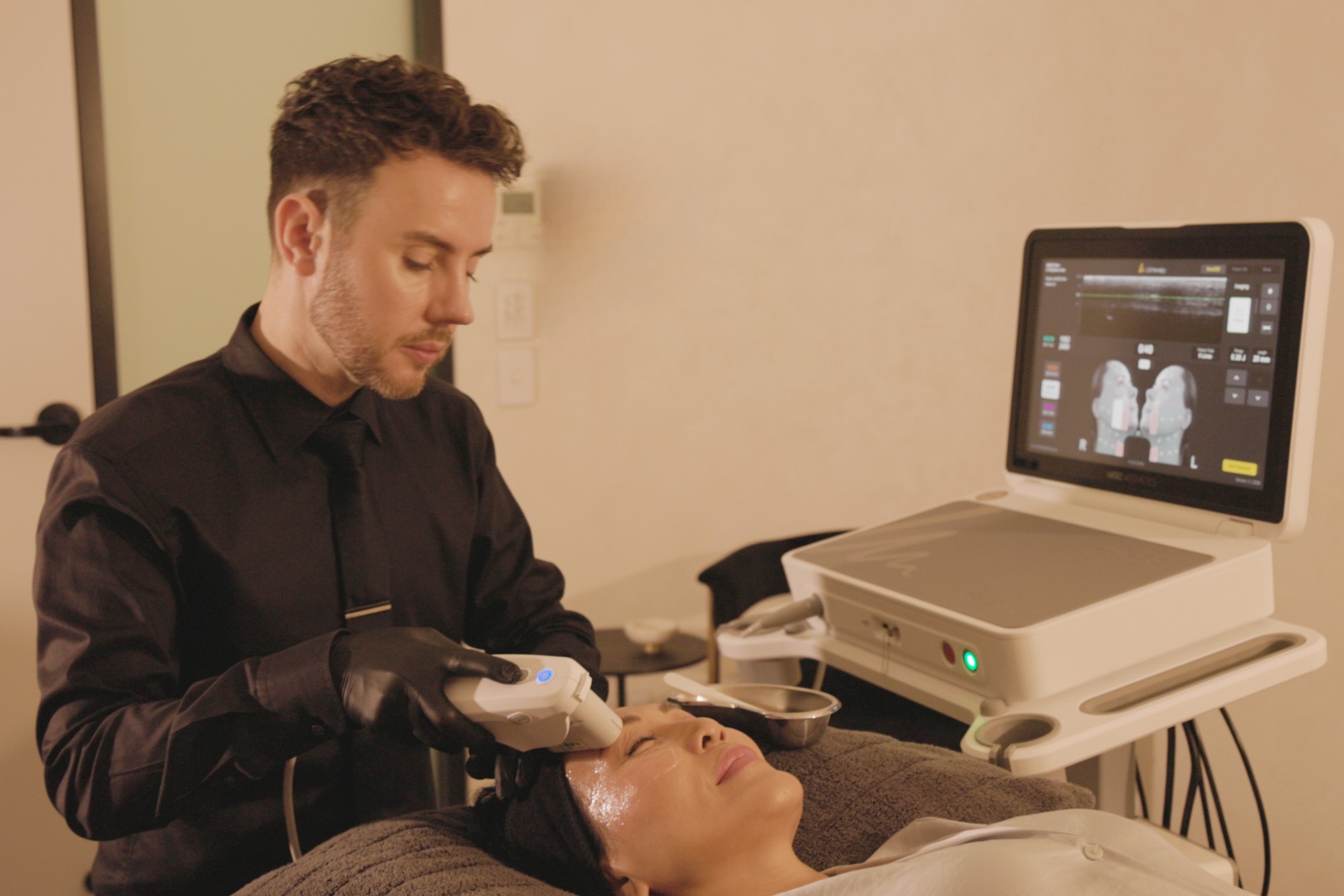
Dr Stephen Lowe performing Ultherapy treatment in clinic using focused ultrasound technology to target deeper structural layers of the face. This image reflects the precision and clinical approach required for non-surgical lifting.
However, outcomes depend on several factors:
- Accurate assessment of facial structure
- Correct depth selection
- Strategic placement of energy
- Individual patient biology
The technology provides the capability — the outcome depends on how it is used.
Ultherapy vs Other Lifting Approaches
Understanding the difference between Ultherapy and HIFU is essential. Ultherapy is often compared to other treatments, but these are not interchangeable.
Ultherapy vs RF (Radiofrequency)
RF-based treatments primarily target more superficial layers and focus on skin quality.
Ultherapy reaches deeper structural layers and is designed to support lifting. A detailed overview of Ultherapy can be found here: Ultherapy Treatment
Ultherapy vs Surgery
Surgical lifting provides immediate repositioning but involves downtime and invasiveness.
Ultherapy provides gradual, natural improvement over time.
Ultherapy vs Volumisation
Volume-based approaches add fullness but do not reposition tissue.
In some cases, this can contribute to heaviness rather than lift.
These treatments are not alternatives — they address different aspects of ageing.
Why Ultherapy Results Vary Between Clinics
One of the most common misconceptions is that Ultherapy produces consistent results regardless of where it is performed.
In reality, outcomes vary due to:
- Differences in treatment planning
- Variability in depth and energy delivery
- Practitioner experience and anatomical understanding
This is why some patients experience meaningful lifting, while others see only minimal change.
Ultherapy is not a standardised treatment — it is a technique-dependent procedure.
Who Is Suitable for Ultherapy
Ultherapy is most suitable for patients experiencing:
- Mild to moderate skin laxity
- Early structural descent
- A preference for non-surgical approaches
It may be less suitable for:
- Advanced skin laxity requiring surgical intervention
- Patients seeking immediate, dramatic change
The best treatment plan often begins with understanding when not to treat.
Expected Outcomes and Timeline
Ultherapy results develop gradually as collagen remodelling occurs.
Typical timeline:
- Early changes: 6–12 weeks
- Continued improvement: up to 6 months
- Duration: approximately 12–18 months (varies by patient)
Outcomes depend on:
- Age and skin quality
- Biological response
- Treatment accuracy
No treatment stops ageing — it only changes the way ageing presents.
Frequently Asked Questions
Does Ultherapy hurt?
There can be some discomfort during treatment, which varies between patients. This is managed appropriately and reflects the depth of treatment.
How many treatments are needed?
Most patients require a single treatment, with maintenance based on individual ageing patterns.
Is Ultherapy worth it?
When performed appropriately and on suitable patients, it can provide meaningful structural support and gradual improvement.
How is it different from other treatments?
Ultherapy targets deeper layers, which are responsible for structural support, rather than focusing only on the skin surface.
A Philosophy Focused on Long-Term Outcomes
Dr Lowe’s approach to Ultherapy is not based on quick changes or visible intervention.
Instead, it focuses on:
- Supporting structural integrity
- Achieving natural, progressive improvement
- Integrating treatment into a long-term plan
The goal is not to look different — but to look unchanged, only better supported.
Learn More About Ultherapy
For a detailed overview of Ultherapy in Sydney, including treatment process, suitability, and expected outcomes:
Explore Ultherapy Sydney
Bangkok, Thailand 17/02/2023
Achieving Optimal outcomes for skin quality improvement through See Plan Treat. Ultherapy Thailand: Seeing Matters
Merz
Melbourne, Australia 25/02/2022
Can single treatment, single depth superficial 1.5mm MFU-V be used for rhytid improvement? ASCD
Merz
Virtual. Global 20/11/2021
Current thinking on biostimulation: MFU-V for accordian lines Merz Aesthetics Expert Summit (Global) “Panel discussion”
Merz
Virtual. USA 11/07/2021
Can single treatment, single treatment, single depth superficial 1.5mm MFU-V be used for rhytid improvement? IMCAS Asia
Merz
Virtual. USA 15/05/2021
Poster: Can single treatment, single depth superficial 1.5mm MFU-V be used for rhytid improvement? ASLMS
Merz
Virtual, Australia 13/11/2020
Evaluation of superficial MFU for the improvement of periorbital, perioral vertical and accordion lines. Non-Surgical Symposium
Merz
Parramatta, Sydney 20/10/2019
Ultherapy for brow rejuvenation The Masters Series: JJ Tour of Aesthetics
Merz
Sydney, Australia 05/04/2019
Ultherapy as a foundation treatment Cosmetex “Panel discussion”
Merz
Sydney, Australia 14/03/2019
Ultherapy as a foundation treatment Cosmedicon
Merz
Media
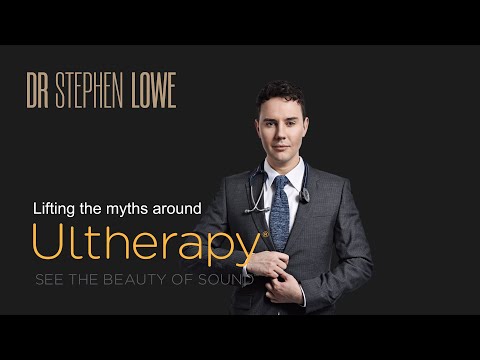
Lifting The Myths Around Ultherapy

 muse@museclinic.com.au
 Get Directions