


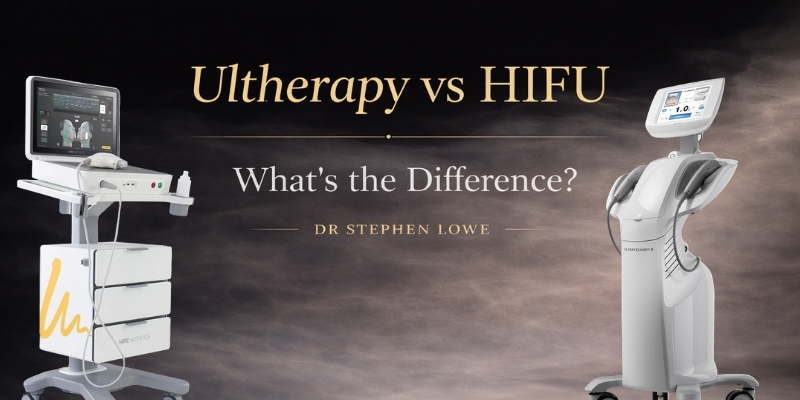
For patients considering Ultherapy vs HIFU in Sydney, understanding the differences between these technologies is important. Ultrasound-based treatments are commonly discussed in non-surgical approaches to skin tightening, with Ultherapy and HIFU often grouped together.
While both technologies use ultrasound energy, they are not equivalent. The differences lie not only in how the energy is delivered, but in how consistently and precisely treatments can be performed. In clinical practice, this difference in visualisation often becomes the defining factor in how predictably treatments can be performed. This distinction is explored in more detail in Dr Stephen Lowe’s clinical approach to Ultherapy.
Understanding these distinctions is important when considering which approach is appropriate.
What Do Ultherapy and HIFU Have in Common?
Both Ultherapy and HIFU (high-intensity focused ultrasound) use ultrasound energy to create thermal points beneath the skin.
These points stimulate collagen remodelling over time, contributing to gradual improvements in skin firmness and support. Treatments are typically performed without surgery, with results developing over several months.
This shared mechanism is why the two are often compared.
Key Differences Between Ultherapy and HIFU
The key difference lies in visualisation and control, supported by ongoing Ultherapy research and publications, and Dr Stephen Lowe’s role as a Global Key Opinion Leader for Ultherapy.
Ultherapy uses micro-focused ultrasound with real-time visualisation, allowing the practitioner to see the layers of tissue being treated and adjust energy delivery accordingly.
In contrast, most HIFU devices do not provide this level of imaging. Treatments are delivered based on standardised settings rather than direct visual confirmation of tissue depth.
When comparing Ultherapy vs HIFU, the distinction is not simply technological, the distinction has implications for precision, consistency, and how treatments are tailored to individual patients.
Why Visualisation Matters in Ultherapy
The ability to visualise tissue layers allows for:
- More accurate targeting of treatment depth
- Greater consistency in energy placement
- Improved alignment between treatment plan and anatomy
Without visualisation, treatments rely more heavily on approximation, which can introduce variability in outcomes.
In clinical practice, this difference becomes particularly relevant when aiming for more controlled and reproducible results.
How Clinical Experience Affects Ultherapy Results
Technology is only one component of treatment.
Outcomes are also influenced by:
- Practitioner experience
- Treatment planning
- Depth selection and energy delivery
Ultherapy is typically positioned within a more structured and clinically guided approach, where treatment parameters are adjusted based on individual anatomy.
This contributes to a more considered and consistent application.
Which Is Better: Ultherapy or HIFU?
It is not necessarily a question of one technology being universally “better” than the other.
Rather, the distinction lies in how predictably and precisely treatments can be delivered, and how they are integrated into an overall treatment strategy.
For patients, considering Ultherapy vs HIFU in Sydney, this often translates to:
- More tailored treatment planning
- Greater consistency in approach
- A clearer understanding of expected outcomes
When Is Ultherapy the Preferred Treatment?
Ultherapy is one of the most established ultrasound-based technologies, supported by a substantial body of clinical evidence and ongoing research, including a range of publications and clinical contributions.
Within clinical practice, including Ultherapy treatment in Sydney, it is often used as part of a broader approach to tissue support and skin quality.
Its use of visualisation distinguishes it from many other ultrasound-based devices.
Ultherapy as Part of a Broader Treatment Plan
Ultrasound-based treatments are rarely used in isolation.
In many cases, they form part of a broader strategy that may also include approaches to regenerative aesthetics, where the focus extends to overall skin quality and tissue behaviour over time.
This layered approach reflects a shift away from single interventions toward more comprehensive treatment planning.
Is Ultherapy TGA Approved in Australia?
For patients considering Ultherapy vs HIFU in Sydney, it is also relevant to consider the regulatory and clinical framework surrounding these technologies. Ultherapy is a TGA-cleared medical device in Australia and has also received FDA clearance in the United States, reflecting a level of clinical validation and oversight that is not always consistent across all ultrasound-based devices. Further information on device regulation can be found via the Therapeutic Goods Administration (TGA).
Conclusion
While Ultherapy and HIFU share a similar underlying mechanism, they differ in how treatments are delivered and controlled.
The presence of real-time visualisation in Ultherapy allows for a more precise and consistent approach, which can influence how treatments are planned and performed. In clinical practice, this distinction often becomes central to how predictably outcomes can be achieved.
As with all aesthetic procedures, results depend not only on the technology itself, but on how it is applied within a structured and individualised treatment approach.
For patients considering Ultherapy in Sydney, treatments are performed at Muse Clinic, where these evidence-based approaches are applied in clinical practice.
Frequently Asked Questions
Is Ultherapy better than HIFU?
Ultherapy and HIFU are both ultrasound-based treatments, but they differ significantly in how energy is delivered and visualised. Ultherapy uses real-time ultrasound imaging, allowing precise targeting of tissue layers, which can lead to more consistent and predictable outcomes in experienced hands.
Is Ultherapy more effective than HIFU?
Effectiveness depends on patient selection and treatment approach. Ultherapy is often considered more reliable due to its ability to visualise underlying structures during treatment, which can improve accuracy and treatment planning.
Why is Ultherapy more expensive than HIFU?
Ultherapy typically involves more advanced technology, including real-time imaging, as well as more detailed treatment planning. These factors contribute to both the cost and the consistency of results.
How long do Ultherapy results last compared to HIFU?
Results vary between individuals, but Ultherapy is often associated with longer-lasting outcomes due to deeper tissue targeting and more precise delivery of energy.

 muse@museclinic.com.au
 Get Directions