


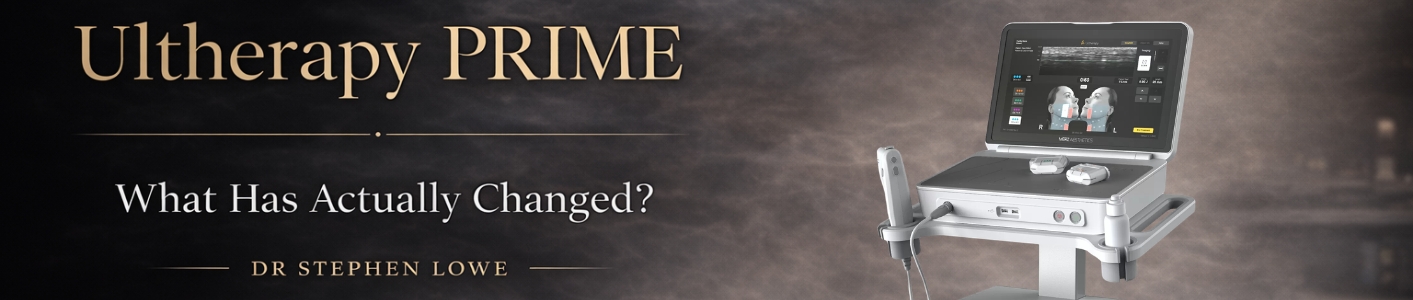
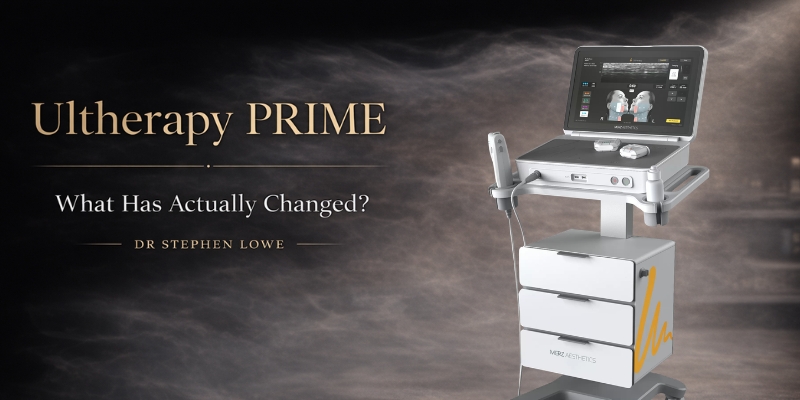
Ultherapy has been a well-established technology in non-surgical approaches to tissue lifting and skin tightening for many years. More recently, the introduction of Ultherapy PRIME in Sydney has raised questions about what has meaningfully changed — and whether these changes alter clinical outcomes.
While it is often positioned as a next-generation platform, the reality is more nuanced. Understanding what has evolved requires looking beyond marketing language and focusing on how the technology is applied in practice. This distinction is explored in more detail in Dr Stephen Lowe’s clinical approach to Ultherapy.
A Brief Context: What Ultherapy Does
Ultherapy uses micro-focused ultrasound with visualisation to deliver energy at specific depths beneath the skin.
This creates controlled thermal points that stimulate collagen remodelling and support lifting in areas such as the brow, lower face, and neck. Unlike many superficial treatments, it targets deeper structural layers that are relevant to tissue support.
This forms the basis of how Ultherapy is applied in clinical practise, including in Ultherapy treatment in Sydney.
As a result, outcomes are typically gradual and develop over several months as collagen is remodelled.
What Ultherapy PRIME Introduces
Ultherapy PRIME in Sydney does not fundamentally change the underlying mechanism of action.
Ultherapy often gets compared to other ultrasound devices, however, they cannot be compared! Ultherapy PRIME represents an evolution in how the technology is delivered, with refinements in:
- Visualisation and imaging clarity
- Treatment delivery and consistency
- User interface and workflow
These changes are designed to improve precision and reproducibility, allowing treatments to be performed in a more controlled and consistent manner. These refinements sit within a broader and well-established body of clinical evidence, as outlined across Ultherapy research, publications, and clinical contributions.
Ultherapy has received regulatory clearance from both the FDA and the Therapeutic Goods Administration (TGA).
Why This Matters Clinically
In aesthetic medicine, outcomes are not determined by technology alone, but by how that technology is applied.
Improvements in visualisation and delivery can:
- Enhance the ability to target appropriate tissue depths
- Support more consistent energy placement
- Reduce variability between treatments
In practice, this contributes to a more refined and predictable approach, rather than a fundamentally different treatment. In many cases, Ultherapy is considered alongside broader approaches to regenerative aesthetics, where the focus extends beyond lifting to overall skin quality and tissue function.
Experience Still Matters
While platform improvements are important, clinical outcomes remain highly dependent on practitioner experience.
Treatment planning — including:
- Patient selection
- Depth selection
- Energy delivery patterns
— continues to play a significant role in determining results.
While technology has evolved, outcomes still vary between patients depending on tissue characteristics and treatment approach. For this reason, newer technology does not replace the need for a considered and individualised approach.
A More Considered Perspective
Ultherapy PRIME should be viewed as a refinement of an already established technology, rather than a completely new category of treatment.
For patients, this distinction is important.
It reinforces that:
- Results remain gradual and biologically driven
- Outcomes depend on appropriate treatment planning
- Technology alone does not determine success
Achieving meaningful outcomes depends on how the treatment is planned and delivered, which is why a more detailed explanation of this approach can be found in Dr Stephen Lowe’s Ultherapy expertise page.
Ongoing Development
Ultherapy continues to evolve through ongoing clinical use, research, and collaboration.
As part of a global group of clinicians involved in the development and refinement of Ultherapy — including Ultherapy PRIME — Dr Stephen Lowe’s work reflects a continued focus on how this technology can be applied in a measured and evidence-based way, as outlined in his role as a Global Key Opinion Leader for Ultherapy.
Ultherapy PRIME in Sydney is rarely considered in isolation. In many cases, it forms part of a broader, layered approach to treatment, where structural support, skin quality, and tissue behaviour are addressed over time rather than through a single intervention. This may include combining technologies or staging treatments in a way that aligns with the biology of ageing, allowing for more measured and sustained outcomes. Within this context, Ultherapy PRIME represents a refinement in how one component of this strategy is delivered, rather than a standalone solution.
Conclusion
Ultherapy PRIME represents a considered progression of an established technology, with improvements focused on precision, consistency, and usability.
Rather than fundamentally changing what Ultherapy does, it refines how it is delivered — supporting a more controlled and predictable approach to treatment.
As with all aesthetic interventions, outcomes remain dependent on both the technology and the clinical approach behind it.
For patients considering Ultherapy in Sydney, treatments are performed at Muse Clinic, where these advancements are applied within a structured and evidence-based clinical approach.

 muse@museclinic.com.au
 Get Directions